The Fell Ponies of Cumbria
If you’re lucky enough to wander the Cumbrian hills, you may stumble upon a small herd of semi-wild Fell Ponies. These hardy, beautiful animals are part of an ancient tradition and play a crucial role in the conservation of our upland fells.
Their grazing habits help regenerate the land, maintaining biodiversity and keeping the landscape healthy.
This autumn, I had the privilege of learning more about these fascinating ponies when I connected with Libby from the Fell Pony Heritage Trust. We spent several hours with a small herd that had been brought down to the lower pastures, and it was an experience that left me deeply moved.
THE DANCE BETWEEN FREEDOM AND DETAIL
When I see a creature in its natural element, it is this elemental relationship that I want to capture. But how to do this? How can we use a two-dimensional medium to express the alive essence of a wild (or semi-wild) being?
Achieving this balance is a dance between accuracy and freedom. I am currently learning calligraphy, and through this practice I have come to
appreciate the importance of repetitive, precise strokes that in time develop a foundation of accuracy and beauty. The same accuracy is needed when painting an animal or bird in order to capture the finer details of eyes, feathers, or whiskers.
However, to counterbalance this level of control, a kind of joyous abandon is needed where fluid, spontaneous moments of movement bring energy and vitality to a piece. Here, rather than dictating how the paint forms on the page, I allow paint and water to dance and shape-shift. In this way, it is as if moments of contraction continuously bleed into moments of expansion, and this dance allows the subject to take accurate form and yet shift into something more.
In the two new paintings I am sharing with you today, inspired by my visit to the Fell Ponies, this dance was especially pronounced. The anatomy of a pony is complex, and their features are intricate and diverse, requiring my attention todetail. Yet this is a creature of open moorland, bound to wild weather and wild sweeping landscapes - I have to let my subject breathe.
Upland Mare is a painting I’ve revisited several times, and I’m thrilled with how it turned out.

‘Upland Mare’ watercolour on cotton paper £650 unframed | £750 framed
WILD DESIGN
In my time with Libby, she shared a wealth of knowledge about the Fell Ponies and their essential role in the environment. As free-roaming grazers, they contribute to the health of the fells, preventing overgrazing and fertilizing the land with each step they take. I was surprised to learn that the ponies, despite being a vital part of Cumbria’s uplands, are not featured in most local tourist literature. Even the National Trust—who manage much of the land—don’t highlight them. They are something of a hidden secret, even though their ecological importance is immense.
I was also fascinated by the ponies' unique coat patterns, known as ‘wolds.’ These patterns—reminiscent of a fingerprint in that they are unique for each pony—serve a crucial function: they channel rainwater off the body, protecting vital organs and even diverting water away from a foal suckling beneath its mother. It’s an astonishing example of evolution’s ingenuity.
The ponies are incredibly gentle, and I found the calm presence of the mares and the curiosity of the young colts and fillies deeply endearing. The way they approached us, inquisitive yet unhurried, was a reminder of the quiet strength of these animals.
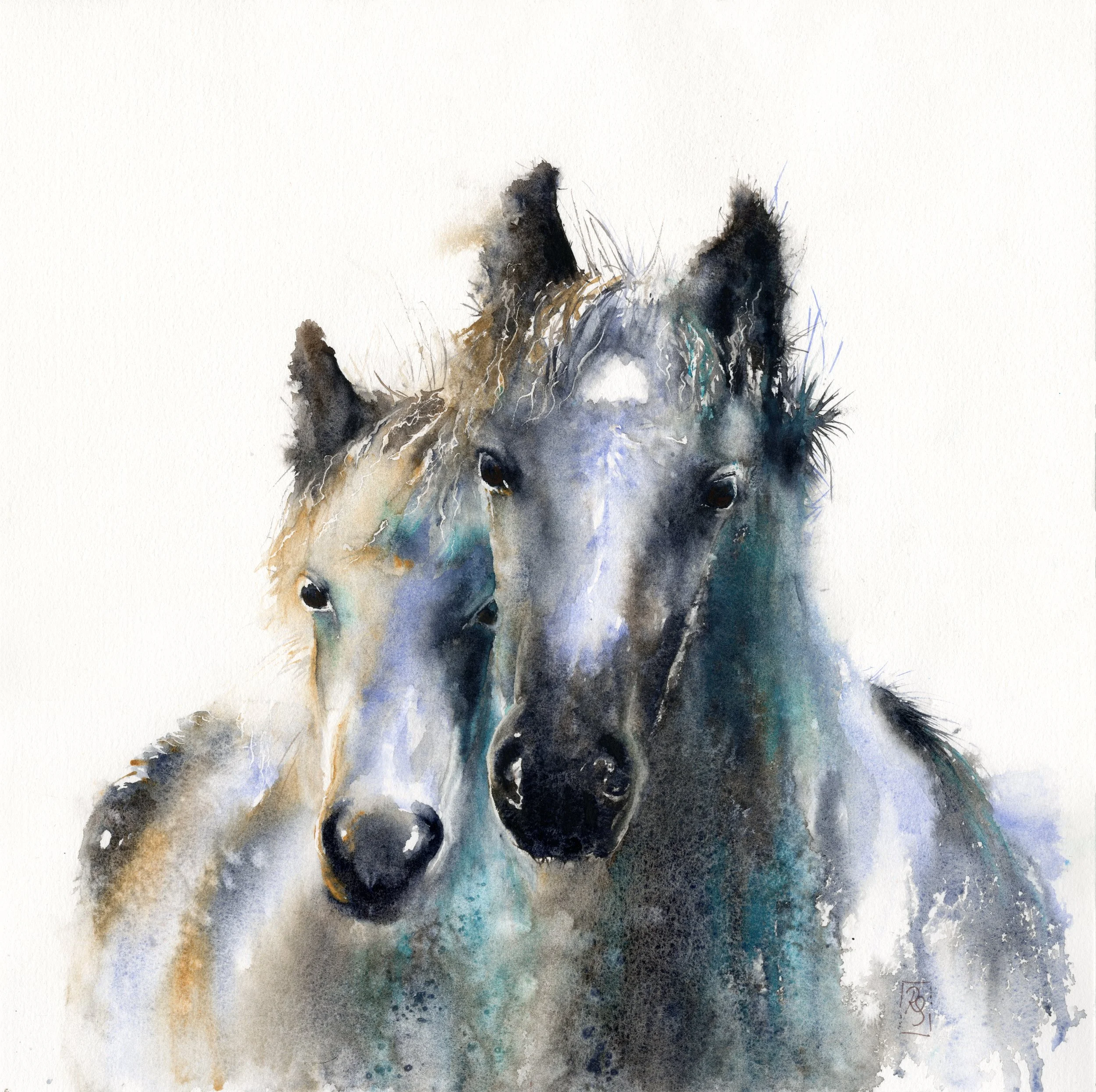
‘Colt and Filly’ 16×16” SOLD