The Sanctuary of a Bird Hide
I glance down the line of people sitting on the benches along from me. Though strangers to one another, each person’s focus and intention, the objects they hold in their hands, the content of their rucksacks and even their very way of sitting, are all practically identical to mine. We are here together, at the same time, on the same day, quite by chance. We are from different parts of the country, and from different generations and demographics. Yet, here we are, in complete solidarity, hushed and alert.
I can think of few other scenarios where strangers sit with each other in this way. Perhaps a library, a church or an art gallery. But in the middle of a pond in the middle of nowhere? This draughty little space, with its row of benches below a tableau of wide-open windows, contains within its square footage a small sanctuary of wakeful awareness - not dissimilar to a library or church.
The focus, however, is not on books or divinity, but on reading the library of Nature and being uplifted by the sublime beauty of wild things.
We are in a bird hide. And we are here to see what unfolds.
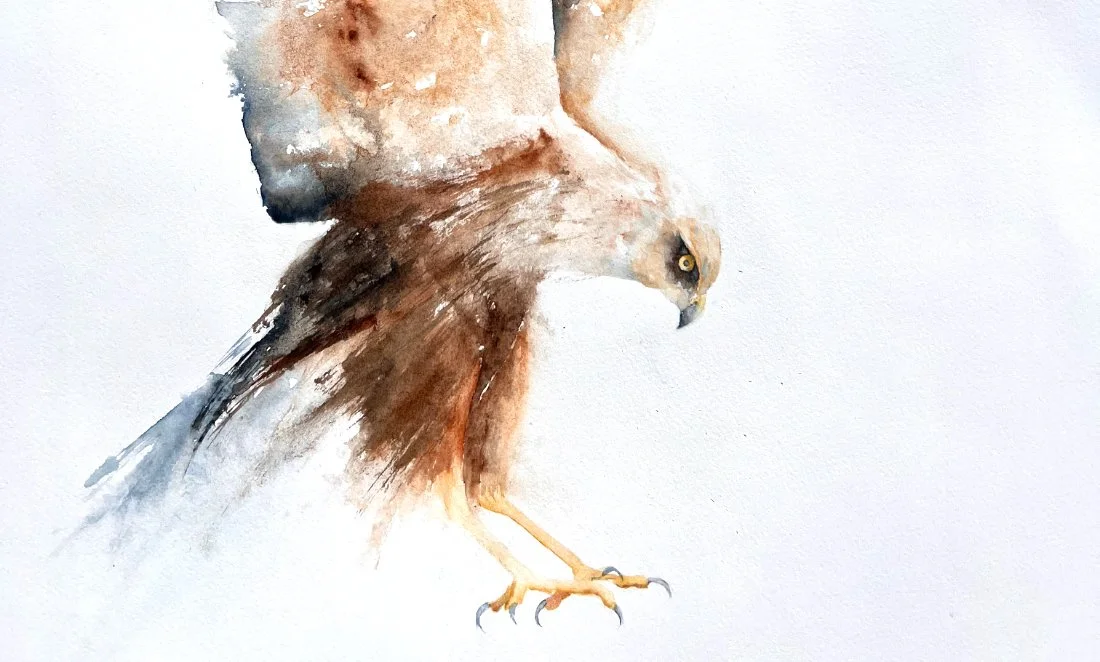
’Sovereign Flight’ - extract from an original painting of a Marsh Harrier, seen from the bird hide at Leighton Moss
LEARNING TO SEE
When I first entered a hide twenty eight years ago I found them uncomfortable and - dare I say it? - boring places to be. If the open windows weren’t letting in freezing cold air, they were letting in biting midges. My very cheap pair of binoculars strained my eyes, and I neither saw very much, nor knew very much about what I was seeing.
The hide we are in now is the same one I was in back then. It is the causeway hide at Leighton Moss and it looks out onto a large expanse of water, surrounded by dense reed beds and, further back, thick scrubland giving way to woodland and fields. Fast forward and this treasure-of-a-site is now the place I can hardly bear to be away from. You could say that I have undergone some upgrades - at every level - so that something boring has turned into something endlessly rewarding and fascinating (more on the upgrades in a moment).
A SHARED EXPERIENCE
Being in a hide, we are effectively hidden in plain sight.
We get to see things without being seen ourselves, to be surrounded by Nature without feeling that we are intruding on it.
From our secluded vantage point we get to witness great crested grebes performing elegant courtship rituals in front of us, adorning their heads with jewel-green watery weeds from the very bottom of the pool, to show themselves in the best possible light to their beloved. We watch a moorhen gently move her tiny punk-headed, bristle-black babies through the watery ways below the hide, whilst our faces soften into smiles. And we see the bittern - an elusive, rare, tawny-brown presence - launch itself from the reeds not twenty feet away and fly nonchalantly past the window, to a collective gasp of awe. It seems we are not the only ones hidden in plain sight.
These moments are all the sweeter for being shared. Entering a bird hide means entering a ready-made community. We are co-conspirators. We have a shared love of Nature and a shared understanding of the value of each precious moment we get to witness.
When someone spots something unusual, the whisper (or an occasional shout if it is something rare and spectacular!) inevitably goes down the line so that everyone has the chance to witness it. The aftermath of shared grins, twinkling eyes, and that rush of energy we always get fills me with joy.
There is a sense of togetherness that is peculiar to birding. It takes time for our heartbeats to calm and our feathers to settle again after such excitement.
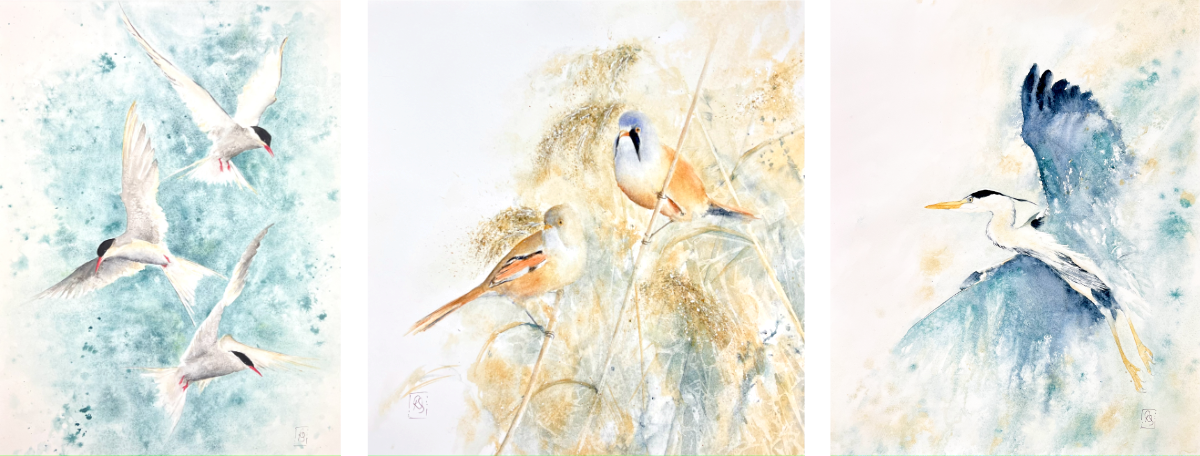
Arctic Terns, Bearded Tits and Grey Heron - all paintings inspired by bird walks around sites in Cumbria
PART SKILL, PART PURE FLUKE!
Back to those upgrades… There are key things that have changed my experience of sitting in a bird hide for several hours from one of acute discomfort to absolute joy.
One is undoubtedly the fact that my ‘optics’ (binoculars and telescope no less!) are now good quality - something I have gradually invested in over time. This means that I can see further and better - into the reeds and rushes as they bend in the wind, right over this shimmering expanse of water, and deep into the scrubland and woodland beyond - all with astonishing levels of light, clarity and precision.
I now have a great deal more know-how: to misquote Hamlet, I can at least tell a hawk from a pigeon (usually). I am better able to differentiate the shape of birds at a distance, their habits of flight and even the level at which they are flying (a buzzard will soar high above us on the thermals, whilst the similarly sized and coloured marsh harrier tends to float low down quartering the reeds below). I now have a good sense of where particular birds might be (the Egret Tree, the Cormorant Tree, Heron Corner, the male marsh harrier’s hunting ground, the stretch of water the spoonbills land on). And I can distinguish some juvenile birds from adults so that I no longer mistake them for another, more exotic, species entirely.
These two things - good equipment and a decent level of knowledge - have made a huge difference. (If you don’t have the knowledge yourself just yet, you can always go with someone who does until you learn enough to enjoy birding for yourself.) Oh and warm clothing for winter, insect repellent for summer, and a flask of hot chocolate for any season. Now every moment seems to offer up something for me to see and hear - a fresh sighting, unfamiliar behaviour, interesting altercations and interactions, an unknown song or call, the return of an old favourite from distant continents.
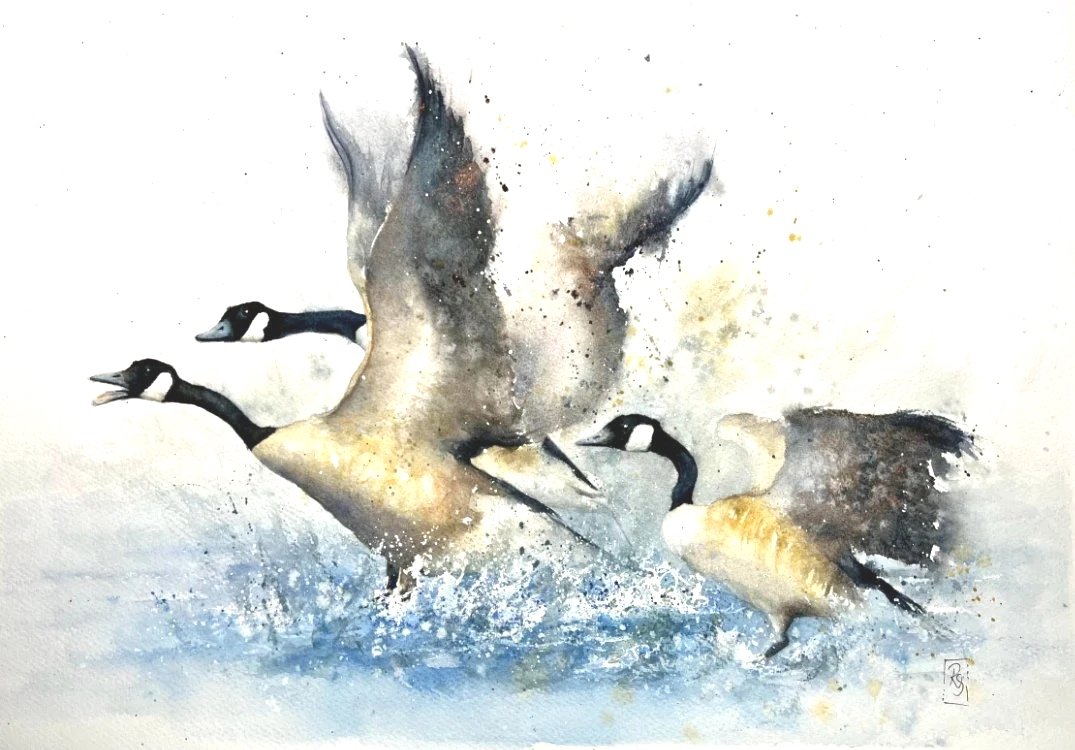
Canadian Geese taking off
INSPIRATION FOR ART
Of course, I also have a deeper motivation for being here: to see and sketch diverse birds in their native habitats, and build a library of ideas for my paintings. As I watch the birds moving in front of me, they feed my imagination and creativity with each turn of their head and every new interesting pose. In considering how they move, how they look in the light, how they appear together - and imagining subsequent paintings leaping to life - I am easily absorbed by all of this, and hours can pass without me realising.
I no longer need patience because I have learned to appreciate whatever show Nature chooses to put on:
I have learned that the simple act of sitting here quietly and attending will yield interesting sights and sounds. This is the way of the wild. It is constantly on the move. There are neither vacant spaces nor moments in Nature. There is never nothing happening: something is always doing something. And if we have the eyes to see, we can watch the wonders unfold.
Some of Nature’s show comes to my attention in spite of me - the elusive bittern flying right past the damn window for goodness sake, so close you can’t miss it! Or a companionable birder pointing out something swooping in on my right when I am looking to the left. And some of it will happen through skill - following a marsh harrier right down into the reeds with my scope and seeing a slender shape just behind its right shoulder that turns out to be a perching hobby.
I love this mix of serendipity and good old-fashioned detecting. When one fails, the other is bound to yield results, and both feel equally thrilling!
THRIVING IN THE MIDDLE OF NOWHERE
It is my hope that there will always be places like this - in the middle of nowhere - where people can come to gather, watching and learning from Nature and each other. I love seeing the car park full each time I visit my local reserve, and meeting families, young couples, and many older people, all here enjoying nature. It warms my heart to see people sharing information and tips back at the cafe.
There are two spontaneous ready-made communities that come here - one of wild creatures, and one of semi-wild humans - and, despite the challenges of our times, both seem to be thriving.